BlogSeptember 23, 2026
Composite vs. Wood Decks for Flower Mound Backyards: Materials, Shade and Upkeep in Texas Heat
Compare composite vs wood deck materials for Flower Mound's heat and storms to choose the right build for your yard.
A deck in Flower Mound lives a harder life than a deck almost anywhere else. It sits through months of high sun, sharp swings between drought and downpour, and afternoons where the surface underfoot matters as much as the grain pattern you chose. So the real question isn't which decking material is best — it's which material suits this yard, this orientation and this way of living outdoors.
This guide walks through the honest tradeoffs between composite and wood decking in North Texas conditions, how upkeep actually differs, and why we treat material selection as a design decision rather than a checkbox. It's written for homeowners in Flower Mound and the surrounding Dallas-Fort Worth communities we serve.
One note on how this article was built: competitor SERP data for this topic was unavailable when we researched it, so we did not summarize or rebut what other pages say. The angle came from keyword and query data alone — composite vs wood deck north texas and deck materials comparison flower mound — both of which point to the same underlying question: how these materials behave here, rather than in a generic national buyer's guide.
Composite vs. Wood: The General Tradeoffs
Both materials build beautiful decks. They simply age differently, and they respond differently to the two forces that dominate a North Texas backyard: direct sun and moisture swings. What follows are the broad, widely understood characteristics of each category.
- Composite decking
- A manufactured board made from a blend of wood fiber and plastic, formed into consistent planks with a factory-applied surface. Because the color and texture are built in rather than applied on site, composite is not refinished the way a wood deck is — it's cleaned and maintained as-is.
| Consideration | Wood decking | Composite decking |
|---|---|---|
| Surface heat in full sun | Naturally porous; dense hardwoods and lighter finishes generally read cooler underfoot than dark, heat-absorbing surfaces | Denser and non-porous; darker boards in particular tend to absorb and hold solar heat, which is worth planning around in full-sun yards |
| Moisture behavior | Absorbs and releases moisture, so boards can cup, warp, check or swell over repeated wet-dry cycles | Far less absorbent, so seasonal movement from moisture is generally less pronounced |
| How it ages | Weathers and greys over time unless refinished; each board keeps its own grain and character | Holds its manufactured appearance longer; fading and surface wear happen gradually and fairly uniformly |
| Upkeep rhythm | Periodic cleaning plus refinishing or sealing to maintain color and protection | Routine cleaning; no refinishing cycle |
| Design feel | Natural grain, warmth and the ability to stain toward a specific palette | Consistent color and texture across the whole surface, with less variation board to board |
That's genuinely the extent of what can be said responsibly without product-level testing data. Once we know which boards are on the table for your project, we bring real samples to the table — literally — and compare them against your home's stone, brick and existing hardscape.
Upkeep: Refinishing vs. Routine Cleaning
The maintenance conversation is where most homeowners make their decision, so it's worth separating the kind of work each material asks for from the amount, which depends on exposure, finish and how hard the deck gets used.
A wood deck asks for a refinishing relationship. Cleaning keeps it healthy day to day, but the protective finish — stain, sealer or oil — is what stands between the boards and the sun, and it needs renewing on a cycle the deck itself will tell you about. Sun-exposed sections almost always need attention before shaded ones.
A composite deck asks for a cleaning relationship instead. There's no finish to strip and reapply, so upkeep is largely about keeping the surface clear of debris, pollen and organic buildup — especially in shaded corners and along the edges where leaves collect. Neither approach is no maintenance; they're different habits.
Texas Heat: Surface Temperature, Sun and Shade
Any deck surface in full Texas sun gets hot. Color and density influence how hot, but orientation influences it more. A west-facing deck takes the worst of the late-afternoon sun — exactly when most families want to be outside — while a north or east exposure stays usable far longer into the day.
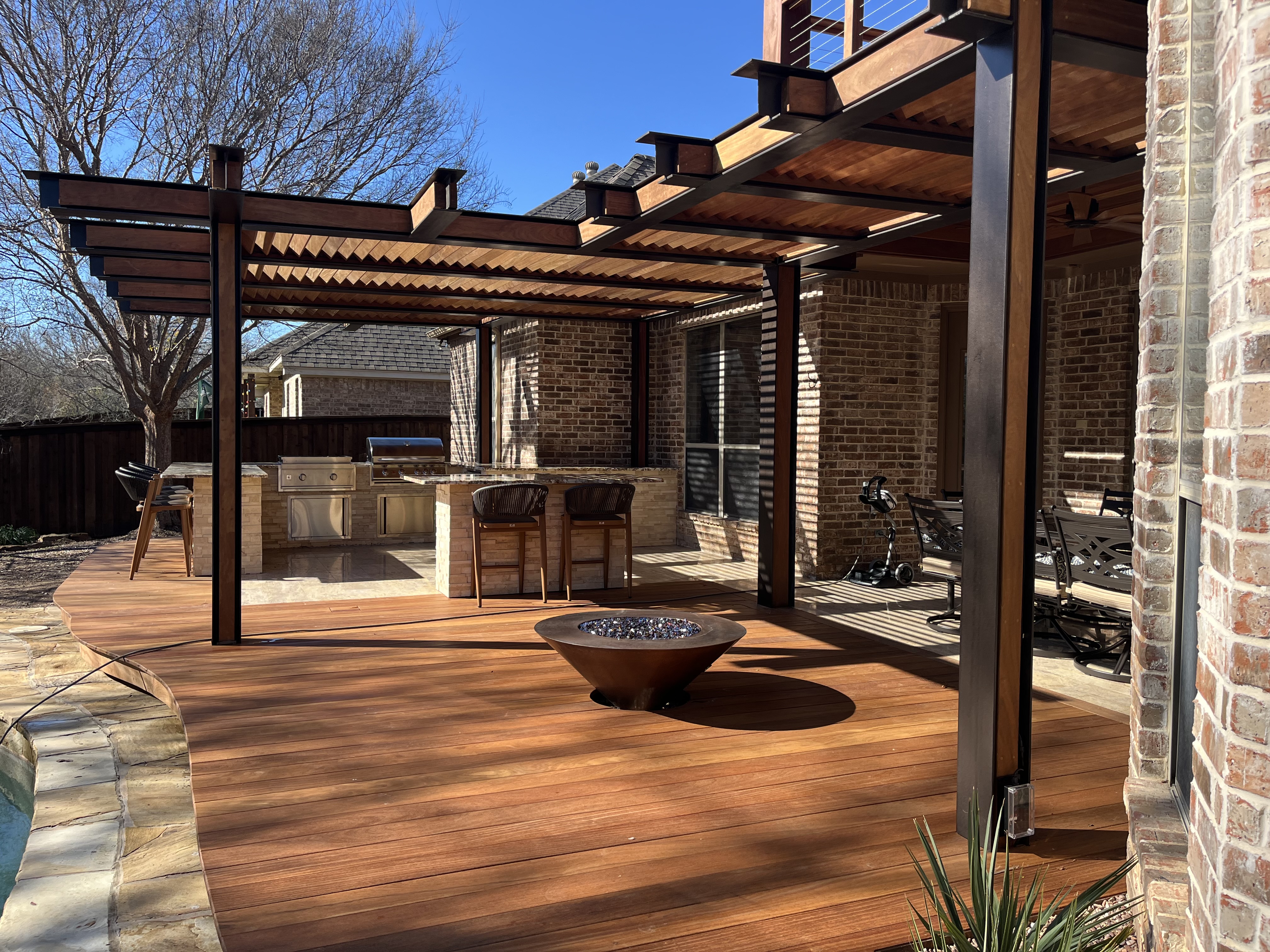
This is why we plan shade and decking together rather than sequentially. A pergola, covered structure or well-placed canopy tree changes the surface-temperature math enough that a material you'd rule out in full exposure becomes entirely comfortable underneath cover. Shade is a design tool, not an afterthought.
We won't rehash the details here, because we've already written them up: our guide to patio covers in Flower Mound covers shade strategy, style and protection in depth, and it's the right companion read if sun exposure is your primary concern.
Why the Right Material Depends on Your Yard, Not a Checklist

Our planning approach is sustainable and site-specific, which means we start with the property rather than the product. Two homes on the same Flower Mound street can need different answers, because the variables that matter are hyper-local.
Read the sun
We map how light moves across the build area through the day and across seasons, including shade cast by the house, mature trees and neighboring structures.
Follow the water
Grade, runoff and how long moisture lingers under the structure all influence material behavior. Where water management is the real problem, irrigation and drainage work comes before decking, not after.
Study the existing palette
Decking has to agree with the home's brick or stone, any existing masonry, and the planting scheme — otherwise you get a beautiful deck that reads as an add-on.
Plan the whole outdoor room
Where the kitchen, fire feature, seating and shade structure land changes traffic patterns, heat exposure and which boards actually get walked on barefoot.
Then select the material
Only once those four are settled does composite-versus-wood become an answerable question — and by then it usually answers itself.
That sequence is the difference between a material decision and a material guess. A checklist can't tell you how your west wall throws afternoon heat onto the boards; a site visit can.
The Terraform Outdoors Difference
Every trade, one team
All work is built in-house. The carpentry, masonry, fire features and planting are executed by the same team working from the same plan, which is what makes a finished space read as one cohesive design instead of a sequence of contractors.
20+ years and 240+ private estates
Two decades of building in North Texas conditions, across more than 240 completed private estates — that experience is what informs how we read a site before we recommend a material.
Sustainable, site-specific planning
We plan around what the property actually gives us: its sun, its drainage, its existing architecture. The result is a build suited to its setting rather than transplanted onto it.
Licensed, insured and family-owned
A family-owned company that is licensed and insured, working across Flower Mound, Southlake, Colleyville, Keller, Grapevine and the greater Dallas-Fort Worth metroplex.
If cohesion across the whole backyard is what you're after, our piece on cohesive outdoor design for DFW estates explains how the one-team model plays out in practice.
Ready to Plan Your Flower Mound Deck?
If you're weighing composite against wood for a Flower Mound backyard, the most useful next step is a conversation about your specific site — its exposure, its grade and how you want to use it. Start with our Decks & Carpentry service page to see how we approach custom decks and covered patios, and our Flower Mound service area page for a look at how we work in this part of the metroplex. Then reach out when you're ready to walk the yard together.
◇ Good to Know